In the spring of 1981, a teenage girl from Webster was killed in a tragic accident at Seabreeze Park in Irondequoit. Peering out her window shortly after the accident, 13 year-old Karen Hunt spotted several of the girl’s friends walking down the street. Moved by the death of someone from her neighborhood and touched by the sight of the girl’s friends walking along the street without their companion, Karen penned 2 poems, which she would share with the girl’s friends.
One was titled “Love Lasts”:
LOVE LASTS
I have lost an old, dear friend.
None of us knew she was near the end.
It isn’t fair she died that way;
Now it is for her I pray.
The tears come again and roll down my face,
For the memory of her I cannot erase.
The sorrow is deep, and will slowly pass,
But our Love for Her will always Last.
The second poem was titled “Somewhere, My Friend”:
SOMEWHERE, MY FRIEND
Something has happened
To keep us apart
But always and forever
You’re in my heart.
Someday soon
From now till forever
I’ll meet you again
And we’ll be together.
I’m not sure how
And I’m not sure when,
Together, Forever,
Somewhere my friend.
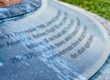
Karen Hunt’s death in the bombing of Pan Am Flight 103 on December 21, 1988 would render both poems eerily prescient. Yet with its hauntingly optimistic tone, “Somewhere, My Friend” has become a significant part of the legacy of those silenced on that bleak evening over 25 years ago. The poem appears on Karen’s gravestone in Webster, on a memorial in New Jersey, and on a plaque in the Place of Remembrance in Lockerbie. The latter would inspire Richard Newbegin to compose “Song for Karen” in 1991.
I read the first 2 stanzas of the poem in a newspaper article published a year after the tragedy—it was the first time I heard Karen speak, in a figurative sense, with her own voice. Though Karen’s death lent an air of melancholy to the verse, the certainty of reunion expressed in the final stanza was comforting.
Decades later, “Somewhere, My Friend,” a poem born of a young girl’s immense compassion, continues to console those who face the deepest loss imaginable—and those who act on their behalf. In an address at the Lockerbie Memorial Cairn in 2010, Richard Marquise, the FBI agent who led the investigation of the bombing for a decade, concluded his speech by reading Karen’s poem. He introduced the reading with these lines: “I have often read the words taken from Karen Lee Hunt’s journal. I think she would be pleased that her words are used this afternoon.”